Architecture
FortranCallJulia is three worlds in one process: a Fortran application, a C
bridge, and an embedded Julia runtime. The Fortran side never touches Julia
APIs directly; the Julia side never sees Fortran declarations. Everything
they exchange passes through the fcj_* C ABI. This page walks the layers
top to bottom, then shows the full system as an interactive diagram.
The Fortran world
Everything here compiles into your executable with gfortran:
- The application layer – examples 01 through 07, from a first
fcj_initcall up to the two capstone executables (reacting_flow,gri_ignition). julia_high_level– the object-oriented SDK:JuliaValuehandles with GC-safe lifetimes, field/property navigation (%element,%property), and batch extraction (%to_fortran) for pulling whole arrays back in one call.julia_low_level– thebind(c)layer offcj_*declarations for callers that want minimal abstraction. This is where the Fast Path lives: a raw function pointer costing ~3.8 ns per call, versus ~815 ns for the generic dispatch path.
The C bridge
src/bridge, eight C source files built into fcj_middleware.a, roughly
105 exported fcj_* symbols. Four concerns, four module pairs:
| Module pair | Owns |
|---|---|
core.c + memory.c |
Lifecycle (fcj_init / fcj_init_ex / exit), thread checking (check_thread()), the GC root set (fcj_map) |
dispatch.c + types.c |
Generic calls (fcj_call*, keyword arguments) and boxing (fcj_box_*) for every scalar type |
arrays.c + extract.c |
N-dimensional zero-copy wraps and deep copies; batch flow of results back to Fortran |
callbacks.c + accessors.c |
@cfunction trampolines (Julia calling Fortran) and field/property access into live objects |
The Julia world
libjulia1.12.7, pinned. The officialjl_*C API, embedded in-process. The pin is load-bearing: comparison baselines must run the same Julia version the bridge embeds, or residuals are meaningless.FortranBridge.jl– five modules (GCManager, FunctionRegistry, Accessors, Callbacks, Utilities) implementing the Julia side of the ABI.FjKinetics.jlv0.2 –AbstractKineticsSolverwithOneStepSolver(OrdinaryDiffEq, FBDF / Rodas5P) andGriSolverfront ends.- The SciML stack, compat-pinned – Catalyst 16, OrdinaryDiffEq 6, SciMLBase 2. Pinned because unpinned drift between these packages silently degrades performance and reproducibility.
ChemMechSim.jl– mechanism input; supplies GRI-Mech 3.0 with 53 species and 325 reactions. Open source; the validation here used v1.2.0.
The path of one call
A forward call walks four hops, with the exception flag checked after each:
Fortran bind(c) caller
  -> fcj_* entry (dispatch, boxing, root-set bookkeeping)
     -> jl_call* / jl_box_* (libjulia C API)
        -> Julia method (FortranBridge.jl or user code)
The reverse direction is symmetric: julia_callback wraps a Fortran
subroutine in an @cfunction trampoline, so an OrdinaryDiffEq solver can
call a Fortran right-hand side on every step. If any hop fails, the call
returns an error code and get_last_error_message() carries the Julia error
text back to the caller.
Delivery forms stack on top of this unchanged: the same calls run JIT (17.3 s cold start), against a sysimage (1.90 s), or AOT-compiled (first call ~12 μs) – see Deployment modes.
The full system, interactively
Open the full version in a new tab – it supports search, path tracing between two nodes, and a guided tour.
If the embedded frame is unavailable (no JavaScript, restricted network), the static preview below carries the same layer structure:
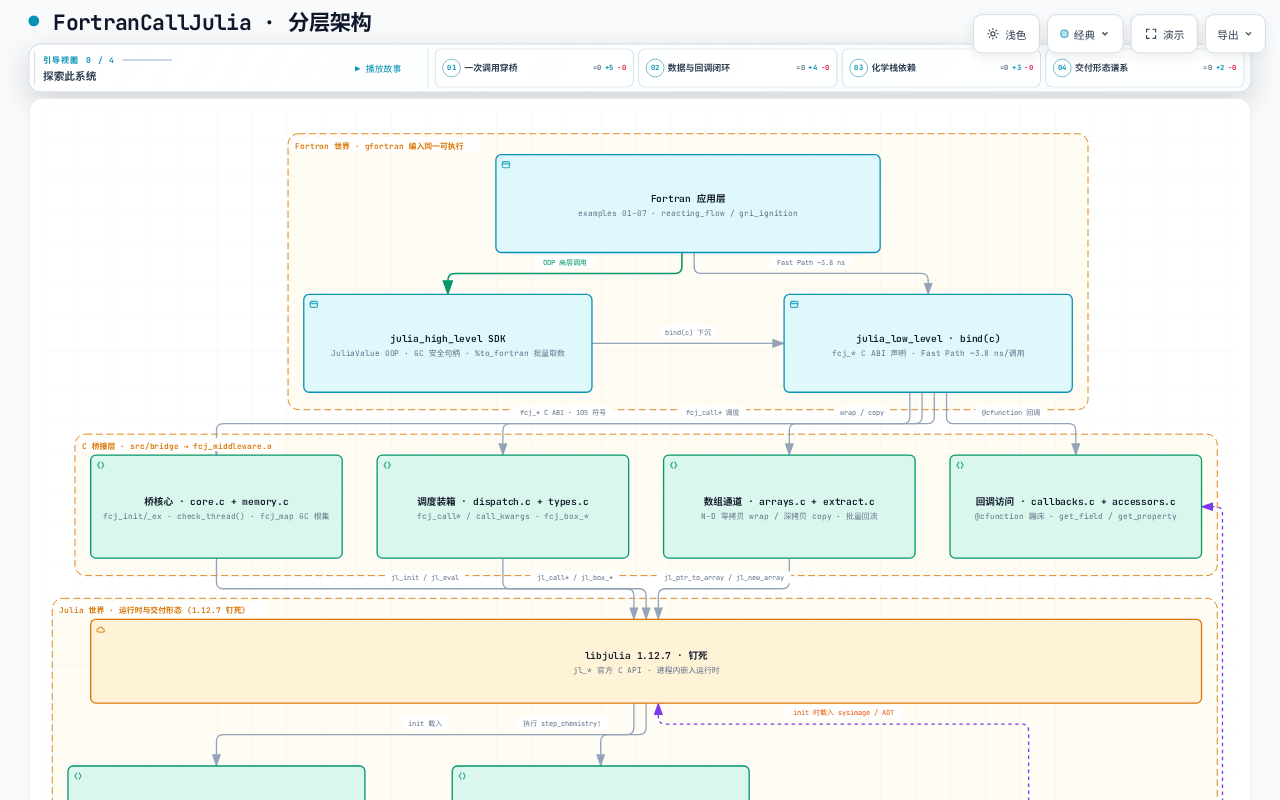
Reading the diagram: the three columns are the three worlds above; edges
crossing columns are the fcj_* ABI and the @cfunction callback path.
The next page pins the whole construction to numbers:
Validation.